
Diagnosis before parts · Emergency calls until 11 PM
AC repair for homes and commercial buildings
Our AC repair covers systems that won't cool, ice up, cycle on and off or trip the breaker. We find what's actually wrong before anything is replaced, you hear back within the hour, and the quote comes in writing so you can decide.
- Response
- Call back within the hour
- After hours
- Emergency calls until 11 PM
- Quotes
- In writing, before any work
- Based in
- Winter Garden, FL
Cloud 9 AC Services repairs air conditioning for homes and commercial buildings across West Orange County and South Lake: split systems, heat pumps, rooftop package units and the thermostats that run them. Every repair starts with a diagnosis, so you pay to fix the actual fault instead of paying for parts swapped until it stops.
We're based in Winter Garden and work across West Orange County and South Lake. We work on rooftop units over shops and split systems beside houses, and the signs below apply to both.
- Where
- Winter Garden, Ocoee, Oakland, Windermere, Horizon West, Clermont, Minneola, Apopka and the towns between
- For
- Homes, and buildings run by property managers, restaurants, retail, medical offices
- Equipment
- Split systems, heat pumps, rooftop package units, air handlers, thermostats & controls
Signs you need it
Signs your AC needs repair
These are the things people call us about, and what each one usually means. One of these is worth a call, and two at once means call today.
-
Running, but the room isn't cooling.
It's usually airflow or refrigerant: a coil starved of air, a slow leak, or an outdoor unit that has quit while the indoor fan runs on.
-
Ice on the lines or the coil.
The coil is colder than it should be, from too little air across it or too little refrigerant in it. A filter fixes the first; a leak needs a gauge set and a tech.
-
Starting and stopping every few minutes.
This is called short cycling, and it comes from an oversized unit, a failing capacitor, a dirty coil or a thermostat in the wrong place. It runs up the bill and wears out the compressor.
-
Tripping the breaker.
It's often a compressor pulling too much current on start, a failing motor or a wiring fault. You can reset it once, but if it trips again, leave it off and call.
-
Water where it shouldn't be.
It's usually a clogged drain line, a cracked pan or a frozen coil thawing out. Left alone, the water damages the ceiling and the repair gets bigger.
-
Warm air, a loud start, a smell when it kicks on.
These are three different faults, and each one gets worse with time. If you smell burning, turn the system off at the thermostat and call.

What we do
How an AC repair visit works
This is what happens between your call and the system running again. The order matters, because the diagnosis is done before any part is bought.
- We listen first. We ask what it's doing, when it started and what's been done to it already. Half the diagnosis is in that conversation.
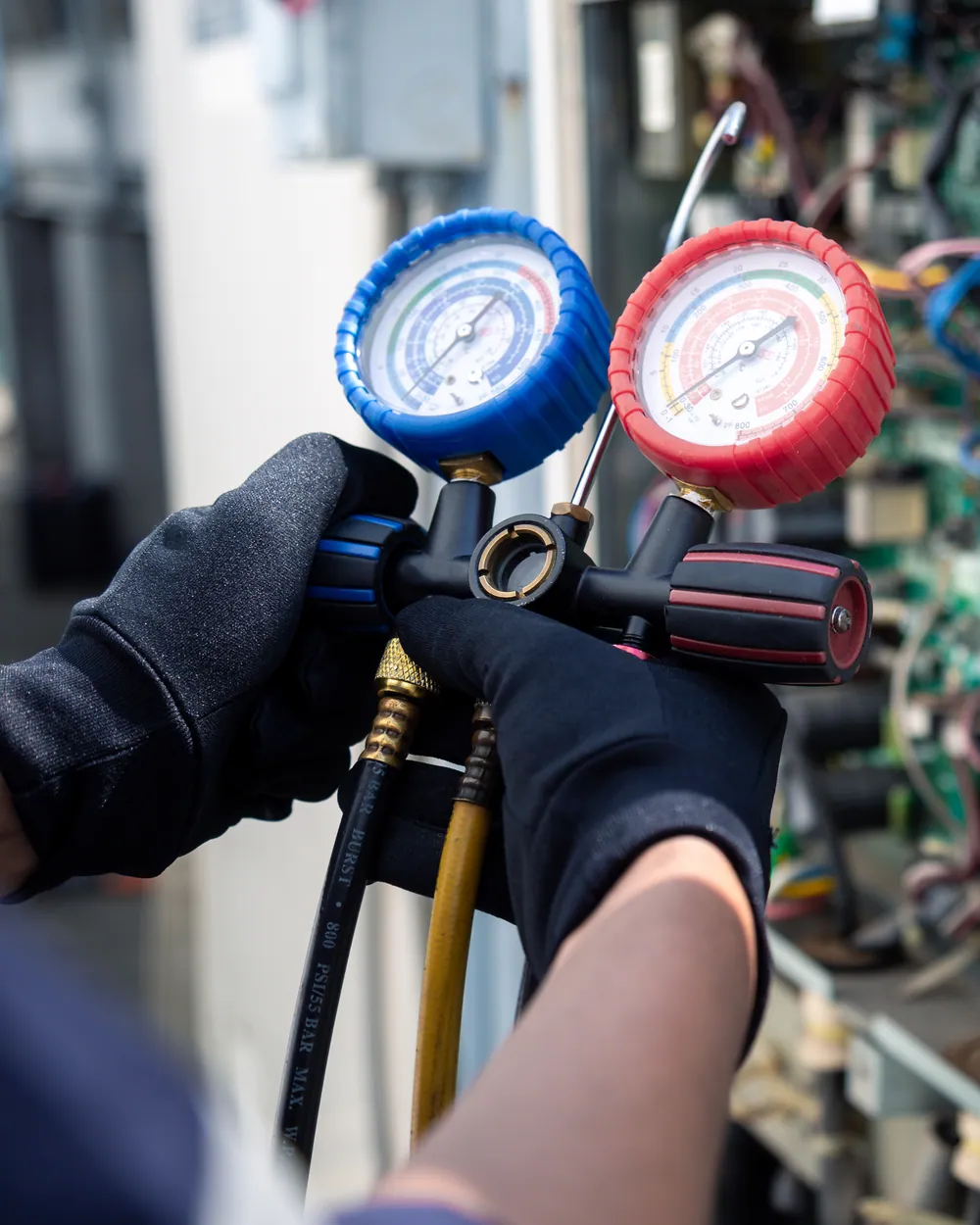
- Then we test with instruments. We check pressures, temperatures, amp draw, airflow and the thermostat wiring. Finding the fault with instruments means the part we replace is the part that failed.
- You get the number before the work. The quote comes in writing, with what's wrong and what it takes to fix it. If the honest answer is that this system isn't worth another repair, you hear that too.
- The fix, with the parts on the truck. The common failures are stocked on the van: capacitors, contactors, fan motors, float switches, thermostats. Most repairs are finished on the first visit.
- A full cycle before we leave. We recheck the pressures, measure the temperature drop at the vents, test the drain, and put the thermostat back the way you had it.
- What to watch next. If something else is wearing, you hear about it now, in writing, with a timeframe and no pressure to do it today.
A rooftop unit over a dining room or a split system over a waiting room fails in front of customers. We work the call around that: roof access arranged with the building, the failed unit isolated so the rest of the floor keeps cooling where the system allows, and the work done early, late or after close when a shutdown would cost you more than the repair.
- Access
- We sort out the lift or ladder tie-off, the roof hatch key and the landlord's rules before the truck leaves.
- Hours
- We take emergency calls until 11 PM, and we schedule planned work outside your busiest hours.
- Tenants
- The property gets notice before the air goes off, and a written note of what was done once it's back on.
The next one is the one you don't have
AC maintenance plans that prevent the next repair
A repair fixes what has already failed. A maintenance plan checks for the next failure once or twice a year, using the same checklist as a tune-up, with the dates already set.
-
The part that was about to go.
A weak capacitor, a half-blocked drain or a pitted contactor gets found on the spring visit and fixed while it's still a small job, before the first 95-degree day.
-
Today's repair, on file.
The diagnosis, the readings and the part that went in are the record. The next visit starts from it instead of from scratch.
-
First in line, and less for the repair.
When the season fills the phone, plan members are scheduled first, and a repair is quoted at a plan member's discount.
What people say after we leave
Google reviews from our customers
4.8on Google · 57 reviews
Read all the reviewsI called Mike at Cloud 9 in a panic when my AC motor went out during this super hot summer, and he went above and beyond to find a part and get it installed quickly.
Shannon P.Google · 2023
I called Cloud 9 at 9:27am on a Wednesday and reached Mike on the first ring. He had me text name and address to him and he would send a tech to our home shortly. Cody, the technician, showed up at 11:00am on the dot.
Laura H.Google · 2022
I can’t recommend Cloud 9 enough! They were very responsive, professional and prompt when I had to have my compressor replaced.
Patrick R.Google · 2026
Questions
AC repair questions and answers
The questions we get when a unit is misbehaving, answered the way we'd answer them on the phone.
Why is my AC running but not cooling?
Most often the cause is airflow or refrigerant. A clogged filter or a blocked return starves the coil of air until it ices over and stops cooling, and a slow refrigerant leak does the same thing from the other side. Less often the outdoor unit has stopped while the indoor fan keeps running, which usually means a failed capacitor or a tripped breaker. Check the filter and the breaker first, and if neither is the problem, call for AC repair so a tech can put gauges on it.
Why is there ice on my AC unit?
Ice means the coil is colder than it should be, and that comes from two things: not enough air moving across it, or not enough refrigerant in it. A dirty filter, a blocked return or a failing blower causes the first, and a leak causes the second. Turn the cooling off, leave the fan on so it thaws, and change the filter. If it ices again, the problem is on the refrigerant side and needs a repair.
Why does my AC turn on and off every few minutes?
Short cycling is the system reaching the thermostat's set point too fast, or shutting itself off before it gets there. The first usually means the unit is oversized for the space, or the thermostat sits somewhere that cools quicker than the rooms. The second is a safety doing its job: a float switch on a blocked drain, a pressure switch on a low charge, a compressor that's overheating. Count the cycle: three or four minutes on, a few off, over and over, and the unit is wearing itself out. It's worth a call before the compressor pays for it.
Why does my AC keep tripping the breaker?
A breaker trips because the unit is pulling more current than the circuit allows. On an air conditioner that's most often a compressor working too hard to start, a failing capacitor, a fan motor that's seizing, or a short in the wiring or the contactor. A dirty outdoor coil can do it too, by making the compressor run hot. You can reset it once, but if it trips again, leave it off and call: every restart is a hard start for the compressor, and that's the expensive part.
What are common fixes for an AC that isn't cooling?
In rough order of how often we see them: a new filter, a capacitor on the outdoor unit, a drain line that has clogged and tripped the float switch, a contactor, a thermostat that was never wired right, and a refrigerant leak found and sealed before the system is recharged. The first one is yours to do. The rest need a visit from a tech, and you get the number in writing before any of it starts.
How do I fix my air conditioner problem?
Four things are safe to check yourself: the filter, the thermostat (set to cool and below the room, batteries fresh), the breaker, and whether the outdoor unit is running and clear of leaves and grass. Those fix a surprising share of calls. Anything with refrigerant, wiring or a motor isn't a homeowner job, and a part swapped on a guess costs more than the diagnosis would have. If none of those is the problem, call us and you'll hear back within the hour.
Ready when you are
Tell us what your system is doing and we'll tell you when we can be there.
The form takes about a minute to fill in. You hear back within the hour with a set time for the visit, so you know when to expect us.
- Mon–Fri8 AM–5 PM
- Sat–SunCall for availability
- Emergency calls answered until 11 PM
- ResponseCall back within the hour